Wednesday, February 22, 2012

Perfection

               Why do we as human strive for perfection? Is it our natural instincts to try to become perfect and do things perfect? Or can we not takes things how they are and live with them as good enough. In Nathaniel Hawthorne’s The Birthmark, he takes this question and poses it to a man who has it almost perfect and pushes the limits of science, love, and perfection.
               Hawthorne’s main character in the story, Aylmer has it all. He is lucky enough to do what he loves to do, which is experiment in his laboratory as an alchemist, and is married to a beautiful woman. His wife, Georgiana, was envied by both men and women who had the opportunity to meet her. She had one problem though. She had a birthmark on the side of her face which “bore not a little similarity to the human hand, though of the smallest pygmy size.” (Hawthorne 85). Despite the envy that his wife draws from others and how beautiful she is, Aylmer cannot get past the fact that she has that birthmark on her face. It truly bugged him and “he found this one defect grow more and more intolerable with every moment of their lives” (86). He then resolves with Georgiana that he is to remove the mark from her face.  Aylmer is striving for perfection in this aspect of his life but also with his work as he is working with new science. He wants this and “possessed this degree of faith in man’s ultimate control over Nature.” (84). In his attempt to remove the mark from his wife’s face, Georgiana dies. This goes to show that perfection may be something that as a human race we may not be able to accomplish.
               The more that people try to become perfect, the more that they can become flawed. I would much rather be married to an almost perfect wife with a tiny hand shaped birthmark on her face than a perfect wife without a birthmark for a minute who dies afterwards. That is the greediness of human nature. We cannot accept what we have and we always want more. People are so often criticized for one flaw that they might have rather than the many unique abilities and characteristics that they have. One example that I can look at is girls who get extensive plastic surgery done to themselves. They do this to change their looks and appearance to others and possibly for themselves. That surgery may make a person feel better about how they look at themselves but what it can’t do is change your qualities as a person. Georgiana was the same person with or without that birthmark on her face because it did not change her personality or the way that she felt about Aylmer. In this case I think that Aylmer acted very selfishly in trying to fix what he say as a defect in his wife, a person that he married despite the fact that she had the mark on her face. Aylmer, as well as a lot of human being should be thankful for what they have and what they are given in life because there are a lot of people who may envy and want what you have much like Georgiana.
               I think that it is human nature to want the best and to want more. If you are the second wealthiest person in the world, you may want to be the richest or if you have envy as a pretty woman you might want to become even prettier because you feel that you yourself aren’t good enough. I think that we take for granted what we have because there are a lot of people who don’t have the money or beauty that another does and would be so grateful for just a chance to achieve that stature. Because much like the outcome that Aylmer experienced by killing his wife, the pursuit of perfection may be thought of as worth it but the end result may change you forever, leaving you a completely different person.

Slavery’s Effects on Blacks and Whites

The inequality that is created by the institution of slavery can not only be degrading to those people who are enslaved in such a cruel and unjust system, but it can also have a negative affect on the people who enslave others. In Frederick Douglass’ book, Narrative of the Life of Frederick Douglass, an American Slave, he is able to display the degrading affect of slavery not only on the slaves but also on the enslavers. Douglass as well as his owners feel these affects through out the narrative of his life as a slave who achieves his freedom from slave to man.

            Through out Frederick Douglass’ childhood, there are a lot of instances where he is subject to terrible abuse and degrading behavior against him. As a youth he learned his first lesson about slavery when he sees the severe whipping that his Aunt Hester receives from their overseer Mr. Plummer. Douglass’ “entrance into the hell of slavery” was marked by this “horrible exhibition” that took place in front of his own eyes and the bloody spectacle that took place had a profound effect upon him (Douglass 51). This was the start of what was to come through out the beginning of his life. As he continues his journey as a slave he has more gruesome experiences that are intended to breakdown the slaves both mentally and physically.

            One main example that Frederick Douglass used to show the dehumanization and the negative effects of slavery on people were with Mrs. Sophia Auld and her change in attitude towards Douglass before and after her inception into the world of slavery. When Douglass first is sent to Baltimore to work for the family of Hugh and Sophia Auld, he is wildly excited and impressed at how well they both treated him. Neither of them had ever owned any slaves and treated him much better than he ever had before. He found that Sophia was so nice that she began to teach him the alphabet and was teaching him how to read. Douglass described Sophia as “a woman of the kindest heart and finest feelings.” (77). This came quickly to an end when her husband demanded that she stop teaching the slave to read. From this moment on Sophia was transformed into a different woman than she was before she became a slave owner. Her demeanor changes and she becomes much crueler to Frederick than she had been previously. After this he would describe her in a whole different light, “That cheerful eye, under the influence of slavery, soon became red with rage; that voice, made all of sweet accord, changed to one of harsh and horrid discord; and that angelic face gave place to that of a demon.” (78). I think that this can be largely attributed to the effects that slavery had on her as a person who is to rule over another human being. Enslavement caused her to change and in some ways dehumanized her and made her less kind and sympathetic as a human.

            Another person who experienced the effects that slavery had upon the enslavers was Mr. Gore. Mr. Gore was the new overseer for Colonel Lloyd as the previous one “lacked the necessary severity” (65). Mr. Gore on the other hand did suit Lloyd’s preference as an overseer. He was a “grave man” who ruled over the slaves with a firm hand and whip. I think that one thing that shows that Mr. Gore was a cruel and inhumane overseer was when he shot Demby in the lake (66). Gore, as a cold hearted person, was unaffected by the result of his shooting of Demby as Douglass said that “A thrill of horror flashed through very soul upon the plantation, excepting Mr. Gore.” (67). With the task of degrading and controlling other humans as a slave overseer, Mr. Gore became unaffected by the mere fact that he killed a man and I think that his job dehumanized him.  

            Slavery was an institution that degraded the slaves and put them into a position of submission to the white slave owners. This broke down the slaves both physically and mentally. But it also broke down people who were doing the enslaving. Sophia Auld was a sweet and kind woman previous to her acquiring a slave and having power over him and Mr. Gore as a brutal slave overseer became immune to such terrible behavior that he was committing. Slavery ruined not only blacks, but white slave owners as well.


Benito Cereno

During our in class discussions of Herman Melville’s “Benito Cereno” there were several interesting points that were brought up regarding the story. Two things that at were brought up in discussion that I found interesting   was regarding Captain Delano and his inability to “read” what was occurring on the San Dominick and whether Babo should be considered the villain of this story. There were several instances in the novel where Benito Cereno and his crew exhibited strange behavior. Delano witnessed such behavior but would dismiss it without questioning it any further. Amongst the various instances one that I thought was interesting occurred when Delano had first boarded the San Dominick. Delano witnesses:
“Three black boys, with two Spanish boys, were sitting together on the hatches, scraping a rude wooden platter, in which some scanty mess had recently been cooked. Suddenly, one of the black boys enraged at a word dropped by one of his white companions, seized the knife, and though called to forbear by one of the oakum- pickers, struck the lad over the head, inflicting a gash from which blood flowed” (Melville 179).
Delano is shocked and questions what he has just witnessed between the black boy and Spanish boy however upon Cereno’s nonchalant response he doesn’t press the situation any further. When I initially read this passage I thought it was interesting because during that era any slave attacking someone that is not of color would be considered a great offense and punished, therefore when Cereno didn’t respond to this or implement any type of punishment for what had occurred to the Spanish boy it seemed very odd. Even Delano states that “had such a thing happened on board the Bachelor’s Delight, instant punishment would have followed” (Melville179), therefore he knew that this behavior was not acceptable but doesn’t choose to regulate the situation himself.  The fact that Delano didn’t press this issue any longer led me to wonder whether he didn’t interfere because this was not his ship and crew? Or did he just not care about what he had seen?  The fact that he accepts Delano’s response as purely a “sport” makes me characterize Delano as naïve because this incident clearly indicates that something is not quite right on the ship.
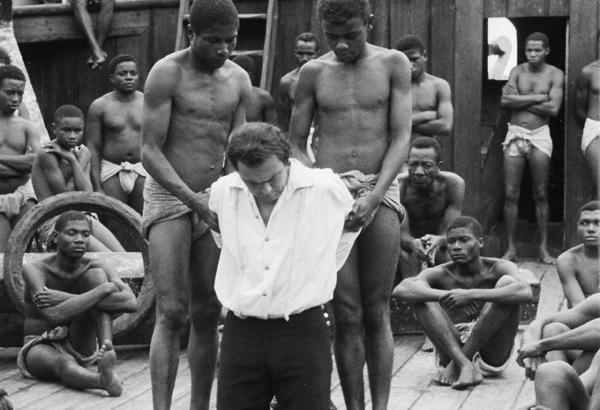
            After various suspicious incidents occur on board, the truth behind Cereno and his crew’s strange behavior is revealed. To Delano’s surprise the ship has been in control of Babo and the slave’s all along. During class the question of whether Babo should be considered the Hero or Villain of the story was brought up. It was definitely an interesting suggestion because I was not thinking about that while I was reading the story. Once I began to think about it I came to the conclusion that I think Babo should be considered the Hero because although he did manage to take over this ship and had the captain of the ship killed we also have to take into consideration what these slaves were going through. Slaves were abused, tortured, overworked and killed by their masters in the same cruel way that Babo and his treated the crew of the San Dominick. These slaves were trying to find a way out from this forced life so as you can see in the novel that would have not been possible unless they gained control and killed the captain in front of their crew as a way of scaring everyone else from trying to fight back. This tactic of killing an individual in front of an audience is something slave owners would do to their slaves to scare them from trying to escape. Therefore Babo and the rest of the slaves were using tactics that they learned from the people who oppressed them.  

Friday, February 10, 2012

The Verdict is Guilty

After finishing Wieland, or The Transformation, I struggled with determining whether or not I believed Wieland to be guilty, or responsible for his own heinous actions. Upon further reflecting on this subject, as well as gathering evidence in the novel, I came to what I believe to be a very solid conclusion. Wieland is in fact guilty for the crimes of murder committed against his very own family.

Sure, Carwin was an outside force that influenced Wieland to murder his wife and children. Wieland believed he heard a voice that was a higher power ordering him to murder his family, and in turn believed it to be a holy and just action. Evidence of this is found on where Wieland is quoted as saying, “The purity of my intentions…the deed enjoined by heaven, extinction of selfishness and error.” (Brown 170) These were the reasons in which I began to not fully blame Wieland for his actions.

Upon further debate, I began to realize that it is Wieland’s failure to question the voice in which he was hearing, and his own assumptions that the voice was in fact the Diety, as to why he immediately turned to murdering his loved ones. Even Wieland’s very own sister Clara is quoted as saying “If Wieland had framed juster notions of moral duty and of the divine attributes.” (Brown 234) Wieland was too easily influenced. Many people have outside forces that may tempt them to commit acts in which they would normally never do. Today this is seen mostly with substance abuse, or the wrong group of friends. But ultimately the decision is still the individual’s to make, and the responsibility of actions still lie with the actual person who commits the act. This is the major reason why I find Wieland to be guilty.

Ultimately, Wieland ends up ending his own life with the penknife. Why, if one found themselves to be innocent and, in turn, free of guilt, would they end their own life? Upon realizing that it was Carwin’s voice, I believe Wieland realized that he could no longer morally justify his own actions, and without justification how can one claim to not be guilty? Furthermore, immediately after he committed his actions he states that, “This was a moment of triumph.” (Brown 165) Triumph?! After murdering his own wife he feels triumphant. This shows a lack of empathy in which a normal person would feel. He then states “I gazed upon it (the corpse) with delight.” (Brown 166). Surely someone who was innocent, who did not WANT to murder his family, would never gaze upon their dead wife in delight. Not only was it Wieland’s own hand by which his family died, but his actions afterwards further prove him to be guilty.

In conclusion, there was too much evidence in the novel proving Wieland’s guilt rather than proving his innocence. Although I cannot definitely know the author’s intentions in creating the character Wieland to be guilty or innocence, I personally found him to be guilty and responsible for the death of his family.

Tuesday, February 7, 2012

Unquestioning Faith

Unquestioning Faith

                People have many different beliefs and religions anywhere you go. Some people believe in God or several Gods, some people are unsure of what to believe in and some people are convinced there is no God. In Wieland, or The Transformation, by Charles Brockden Brown, Wieland had an unquestioning faith in his religion and he believed it was his duty to serve God and this lead to his downfall. This also leads to the dispute, is it wrong to have faith in something and never question it? Wieland was wrong when he believed God told him to murder. It was actually Carwin that he was hearing but if he had spent more time thinking about what the voice was telling him to do and if he tried to make a judgement for himself wether it was right or wrong, he may not have murdered his own family.
            Wieland interprets the voices he hears as his duty. He says, “Undone! No; my duty is known, and I thank God that my cowardice is now vanquished, and I have power to fulfill it” (Brown, 165). He doesn’t question his “duty” for one second. He hears a voice and takes it as an obligation without ever considering ignoring it. Wieland is a puppet to his belief. He even praises God for giving him the courage to commit the murder, instead of looking within himself for the courage.
            Wieland murders his wife. The woman that he loves and has sworn an oath to. Yet after he murders her, he is happy that he made the sacrifice. He says, “To that I have sacrificed, O my God! Thy last and best gift, my wife!” (166). I think most people in Wieland’s situation would not kill their own wife because God told them to. Even if a person believes in God and they truly believe God is ordering them to kill someone, I think most people would decide that their wife is more important than their faith. This is an instance that proves that an unquestioning faith is wrong. If Wieland had questioned his beliefs, he may not have gone through with it.
            Wieland’s devotion to his beliefs causes him to be unhappy. He says, “Dissatisfaction has insinuated itself into all my thoughts. My purposes have been pure to me, my wishes indefatigable” (159). Wieland would probably be happier if he did not allow his faith to take over his life. If he had balance, he would probably not be so miserable and he would still have his family. This shows again that it is bad to have an unquestioning faith in something because it can consume you and become all that you care for.
            By looking at Wieland and his actions, I think that it is wrong to have an unquestioning faith. I don’t have anything against religion or people who are religious but I think that it is necessary for people to think for themselves. An exaggerated example of this in real life would be Charles Manson, and his followers. Manson was able to convince people to go around and commit murders and his followers had an unquestioning faith in him. This faith led these people to make some bad decisions. If people do not question their decisions or consider alternatives, then they are not really living their own life and many of their actions will probably be irrational just like Wieland killing his own wife.

Monday, February 6, 2012

Carwin: Accomplice to murder?


   The in class trial regarding whether Wieland be held responsible for the death of his wife and children created a great discussion. However it also prompted the question of whether Carwin should be held responsible for his actions and his influence over Wieland. In the trial the group arguing that Wieland was innocent argued that Carwin is the one who is 100% responsible for Wieland’s actions. Although I don’t agree that Carwin is 100% responsible for the crimes committed in this novel, I do agree that Carwin should be held responsible taking advantage of Wieland. As well as having influence over Wieland’s actions.
            It is no mystery that Wieland is the individual responsible for physically murdering his wife and children; as he confesses to the crime himself. However, his reasoning behind his heinous crimes is based on his devotion to God. He states that “it is needless to say that God is the object of my supreme passion” (159). Wieland claims the voices he was hearing were coming from a higher power. He states “As it spoke, the accents thrilled to my heart: -‘thy prayers are heard. In proof of thy faith render me thy wife. This is the victim I choose. Call me hither, and here let me fall.’ The sound, and visage, and light vanished at once” (161). The murder of his wife is identified through Wieland’s eyes as a sacrifice to God. However, what he was not aware of was that these voices were coming not from God but from Carwin.
            Although it was Carwin who was manipulating everyone with his unknown mysterious voices his confession to his actions brings to light the extent of his involvement in Wieland’s crimes. He states “Great heaven! What have I done? I think I know the extent of my offenses. I have acted, but my actions have affected more than I designed. This fear has brought me back from my retreat. I come to repair the evil of which my rashness was the cause and to prevent more evil. I come to confess my errors” (188). Carwin show’s great remorse and guilt as he confesses to Clara that he has been the one producing the voices that Wieland, Pleyel and she have been hearing. It is clear by his reaction that he is aware of his wrongdoing and the harm that his actions have caused. However he is quick to clear his name of the murders as he states “I am not the villain. I have slain no one; I have prompted none to slay; I have handled a tool of wonderful efficacy without malignant intentions, but with caution” (190). If his intentions weren’t malignant at all then why is it that he shows so much guilt and remorse to Clara? Why is he trying to clarify his actions? He wouldn’t be feeling guilty if he didn’t feel that he had done something wrong, which he has. It is true that he was not the one who murdered but if it wasn’t for his use of ventriloquism he wouldn’t have mislead Wieland into thinking that he was receiving orders from a higher power.
            The reader is never truly told Carwin’s reason and intentions to why he decided to manipulate Wieland and the rest of the characters. Although he doesn’t admit it he was trying to stir some type of controversy by manipulating Wieland and scarring the other characters. He knew his ventriloquism gave him some type of power that none of the other characters had so he used it to his advantage until it went too far and caused harm. Carwin took advantage of Wieland's religious views and commitment and used him as his prey. Like Clara stats “Carwin was the instigation” (209). He wasn’t the one who committed the crimes but he was the one who gave Wieland the final push to commit those crimes making him an accomplice.