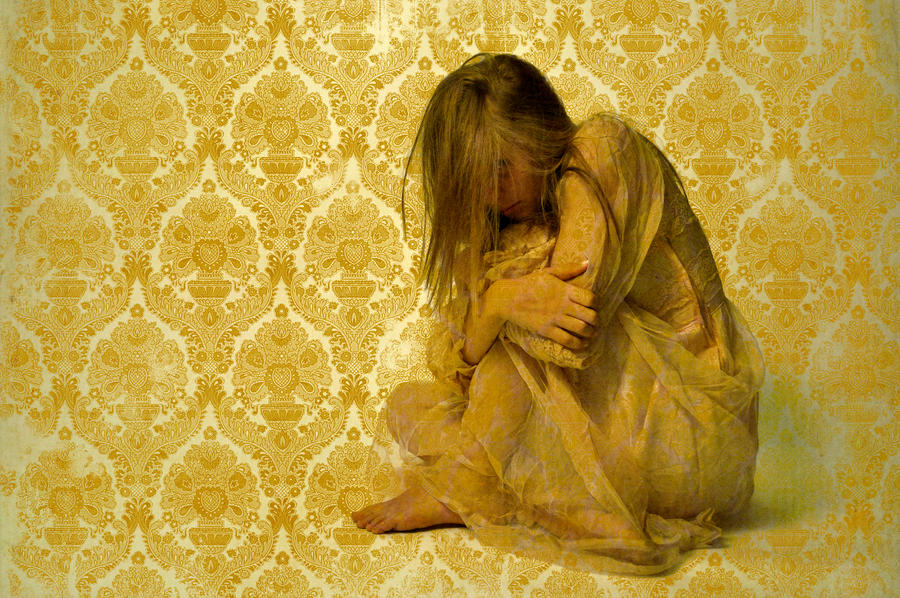
In Charlotte Perkins Gilman’s, “The Yellow Wallpaper” we are submerged into the first person journal of a woman that is being confined in a room by her doctor husband, John. During our discussion of this short story questions were brought up regarding the narrator’s state of mind. Is she really suffering from a psychological disorder, or is her behavior result of her trying to lash out against her husband’s over controlling ways. Although, there are passages in the story that could support both argument’s I believe that the narrator was suffering from a physiological disorder; specifically Postpartum depression.
Postpartum depression is a type of depression that affects some women after they have given birth. Postpartum depression can range from moderate to severe and symptoms can occur anytime after the delivery or even a year later. Symptoms include agitation, irritability, anxiety, changes in appetite, feeling withdrawn or unconnected, thoughts of death or suicide, trouble sleeping, etc. Mother’s who are diagnosed with Postpartum may also be unable to care for the baby or have negative feelings towards the baby. If diagnosed with Postpartum it is suggested that the mother not be exposed to major life changes after giving birth, that they rest as much as they can, and that they be surrounded with friends or their partner. After looking more deeply into what postpartum depression is and some of the symptoms that come along with it, I started to draw connections with the narrator.
Right away the narrator brings establishes the setting and reveals that she is being confined to a room in summer home by her physician husband. She also discloses that this confinement is a result of her husband diagnosing her with a “temporary nervous depression” (1). This is the first sign that shows the reader that something is not quite right with the narrator. One could easily argue that this could be any type of psychological depression however she later reveals a significant detail regarding her current situation. The narrator states, “It is fortunate Mary is so good with the baby. Such a dear baby! And yet I cannot be with him, it makes me so nervous” (4). The narrator has recently given birth and as she states it is obvious that the baby is not under her care. Women who have postpartum depression usually feel high levels of anxiety when separated from their newborns. In many cases separating the newborn from their mother can intensify and worsen a mother’s symptoms. The fact that the narrator is separated from her child could explain why her manic behavior intensifies throughout the story.
During this time period there was no official title or established research for postpartum depression. Therefore it would explain why the narrator and her husband are not entirely sure of what is occurring to her. Women or even men who experienced psychological episodes would in many cases immediately be deemed insane and shipped away to a psychiatric hospital. We can see this already happening in the story as the narrator talks about the way her husband wants to renovate the room she is in. She states, “He said that after the wallpaper was changed it would be the heavy bedstead, and then the barred windows, and then that gate at the head of the stairs and so on” (4). Her room already resembles a psychiatric room, which reaffirms the idea that her husband thought she was going crazy. However, seeing that there was no official connection between child birth and depression he obviously was not aware of the true diagnosis of her condition.
It has been suggested that in some cases of postpartum depression that women be surrounded by their loved ones and watched closely. In this story the opposite is being done, the narrator is being completely segregated from seeing anyone for long periods of time. Referring to a conversation with her husband she states, “‘I don’t weigh a bit more,’ said I , ‘ nor as much; and my appetite may be better in the evening when you are here, but it is worse in the morning when you are away!’” (9). Here the narrator identifies that she does not like being alone. It’s almost a cry for help to her husband. She wants to have someone around and even points out that then he is not around that her symptoms are much worse when he is not around. She even points out that she has no appetite; this is another symptom that women with postpartum experience. However, unaware of what she is truly feeling her husband is only making her situation worse.
Another indicator that she is suffering from postpartum is the narrator considering suicide. As the story is almost coming to an end she states “I am getting angry enough to do something desperate. To jump out of the window would be an admirable exercise, but the bars are too strong even to try” (14). As previously stated women with postpartum sometimes have thoughts of suicide but in many cases don’t actually go through with it. Here in the narrators manic moment the she seems absolutely fed up with everything she has been experiencing and for a moment thinks’ about jumping out the window to end her life. However, she does not go through with it because she fears it would be “improper and might be misconstrued” (14). The final breakdown she experiences with the wall paper can be seen as her depression worsening and a final cry for help. Terrified by her behavior her husaband faints in horror and one is only left wondering what the fate of our narrator is.
Sources I used on PPD:
http://www.webmd.com/depression/postpartum-depression/postpartum-depression-topic-overview

I agree almost completely with Jazmin's argument that the narrator is in fact suffering from post-pardum depression. The author continuously throws hints into the story that can lead the reader to perceiving her behavior as this mental disorder. The mentioning of the narrator's baby who she is not even caring for at the time, and the erotic behavior such as the believing the wallpaper to come alive, all clue the reader in that, mentally, something is not right. I disagree with Jazmin, though, in her perception of the narrator trying to jump out of the window as a conscious effort to take her own life. I think that the narrator is simply not completely mentally strong, and therefore cannot be perceived as being aware of exactly why she is doing the things she is doing.
ReplyDeleteI agree with what you’ve said, but I also feel the gender inequality in “The Yellow Wallpaper” can be attributed to why women on the rest cure rebelled. The influence of the patriarchal figure in the story, John—and Dr. S. Weir Mitchell—in real life contributed to the rebellion of women on rest cure because of the suppression by men.
ReplyDeleteIt is indeed very interested how throughout time, the role of the inferior character becomes less naïve chronologically. Gender inequality continues to exist because there are double standards that men hold women to but don’t hold themselves accountable to because the role of the superior character is very hypocritical.
Charlotte Perkins Gilman uses irony in order to address and criticize the gender inequality between men and women.